4 Things to Understand About How Yoga Builds Strength
There’s been an idea lingering with me lately. It started while I was thinking about teaching, my own yoga practice, and your responses to my last newsletter, especially the part where 40% of you said you’re still trying to figure out fitness in your 40s,.
^^^Of course you are, because by this stage of life, it’s not that you don’t know what matters.
You already know that movement matters, that strength matters, that mobility, balance, breath, recovery, consistency, *all of it matters*
& yet somehow, knowing all of that hasn’t made it feel any *simpler*.
I think it’s because so much of the fitness world is still built around pressure, performance, punishment, and proving yourself, instead of building a relationship with your body.
Yoga Was Never Meant to Be the “After”
So why does it get pulled into that misunderstanding too?
We start to believe it’s something we’ll get to later;
once we’re more flexible
once we’ve gotten back in shape
once life finally calms down a bit.
But that’s never really how life works.
And it’s *NOT* how yoga practice works either.
Because yoga was never meant to be the reward for finally getting it together.
It’s one of the ways you BEGIN.
This Is the Part of Movement That Actually Changes Things
I read something recently about teaching — the difference between a good teacher and a great one. A good teacher can teach people who want to learn, but a great teacher can inspire people to want to learn.
And most of what we’ve been taught about movement lives in that first category. Because it’s not hard to tell someone what works;
What strengthens your core.
What opens your hips.
What sequence helps with stress.
What kind of movement is best for women navigating hormonal shifts of midlife.
Information. Is. Everywhere.
BUT.
Helping someone feel safe {AKA read here….Why Yoga Might Just Be Your Game-Changer?} enough to return to their body, helping them trust it again, helping movement feel kind instead of corrective, possible instead of overwhelming…
…that is something else entirely.
And *THAT* is the part I care about. 👯♀️💛
Because women in their 40s don’t need more instructions delivered with urgency or pressure, as if the stakes are always high and time is always running out.
They need SPACE,
&someone who understands
that this season can feel full in ways that are hard to explain
that your body might be changing
that your energy might be shifting
that your schedule might feel more layered than ever,
&your relationship with movement might be carrying years, sometimes decades, of quiet history.
We’re Not Just “Working Out”. We’re Building a Body
So when I’m teaching yoga, yes!!, I want you to learn something in the room, but more than that, I want *what* you experience there to follow you home.
Because some of what we’re practicing is subtle.
It is way you stay with a sensation instead of rushing past it, the way you notice your breath when something feels hard, the way you respond to yourself when things don’t go the way you expected.
✨ Those are psycho-emotional skills. Philosophical ones. Even spiritual, in their own quiet way. ✨
But there is also something very tangible happening at the same time.
We are building a BODY.
Not in the performative sense, not in the way the industry often talks about it, but in the deeper, more functional sense of the word. A body that can support you.
A body with stability, with endurance, with enough strength to carry you through long days, unexpected stress, and everything life asks of you.
And when you have a body that works in a more integrated way {AKA….having a good balance of strength profile},
🛠️ it works more efficiently
🛠️ it works more evenly
🛠️ it works more congruently.
A body that can hold your life, not just look a certain way while living it.
strength plays a central role in that.
Not as something separate, but as something that brings everything else together, that
SUPPORTS
ORGANIZES
COORDINATES
the systems you are already working with.
Unfortunately, this is where most women get stuck.
Not because you don’t know what to do…
but because it doesn’t feel sustainable.
Because the goal isn’t just to get you to work out.
It’s to help you build something you can actually keep coming back to.
Because when strength is present in a balanced way, the body stops feeling like a collection of parts you are trying to manage, and starts feeling like a system that works together.
1. Strength absorbs and distributes load
Strength is not just about producing force. Its primary role is to absorb and distribute load.
And so, every time you move, in yoga or in daily life, force goes through your body. That force has to be managed somewhere.
If the system is strong, that load is shared across multiple tissues: muscles, connective tissue, joint structures. If the system is not strong, the load gets concentrated. {And it usually concentrates in the same places: areas that are already more mobile, or less supported.}
A simple way to understand this:
When force is spread across a larger area, each structure does less work. When force is concentrated, one structure does too much = that’s when things start to feel irritated, unstable, or strained.
^^^ In yoga, take any arm balances. When you shift your weight forward into your hands, your wrists, shoulders, and core are all taking load. If that load isn’t being supported by enough strength, it doesn’t disappear. It drops into the wrists, {AKA that’s when people feel pressure, discomfort, or instability}.
But when the system is strong, the same shape changes. The load is shared, the shoulders help carry it, the core organizes it; and the wrists are no longer doing the job alone.
That’s the difference. Same pose, different distribution of load.
This is the key point:
You don’t reduce stress on the body by avoiding load. You reduce stress by increasing your ability to manage load.
And this matters more as you get older.
Because the goal is not just to move. It’s to move in a way that your joints and tissues can tolerate, consistently, over time.
2. Strength creates stability; and stability is what allows you to use your mobility
In yoga, there’s often a strong focus on increasing range of motion. But range on its own is not the goal.
What matters is WHETHER, YOU can control that range.
Strength is what creates that control. It gives you stability.
And stability is what allows movement to happen in a coordinated, efficient way.
Every movement you make depends on having something stable to move from.
If there’s no stability, the body has nothing to organize around.
A simple way to understand this:
Movement requires force. And force requires a stable surface to push into.
^^^ This shows up a lot in yoga. You might feel like your hips or hamstrings need more flexibility. But what’s often missing is strength around those joints. When that strength improves, range often improves with it, because the body can actually control it.
This is the key point:
Mobility is not just about how far you can go. It’s about how well you can control where you go.
Strength gives you the foundation for that control, {..and without it, more range doesn’t necessarily make you move better}. It just gives you more space that you can’t fully use.
3. Strength and flexibility are not opposites. they depend on each other
There’s a common assumption that strength and flexibility sit on opposite ends of a spectrum.
They don’t. They work together.
Flexibility gives you access to range. Strength determines whether that range is usable.
If you have range but no strength to support it, the body has very limited options once you get there.
A. It either avoids the position… or
B. It collapses into passive structures; joints, ligaments, connective tissue.
That’s where flexibility becomes a liability. Not because flexibility is a problem. But because it’s unsupported.
^^^ In yoga, this shows up very often. Many people can move into deeper shapes. But they can’t control themselves once they’re there. There’s no ability to adjust, stabilize, or generate force from within the position.
When strength exists, that changes.
You don’t just reach a position. You can hold it, organize it, and move within it.
This is the key point:
Range without control is not functional. Control is what makes range useful. And for most yoga practitioners, flexibility is not the missing piece.
It’s usually already being trained.
What’s often missing is the strength to support that range.
When you build that strength, two things happen: You gain more control over the range you already have. And in many cases, you can safely access more range; because the body trusts it.
So the goal is not just to go further.
It’s to be able to do something with the range once you’re there.
4. Strength improves body awareness and control
Strength doesn’t just change your muscles.
It changes how well you can sense and organize your body.
Every time you do a strength-based movement, you’re not just training tissue.
You’re training your nervous system. You’re improving the communication between your brain and your body.
This is what allows you to feel:
– Where your body is in space?
– How weight is being distributed?
– What holds you in place?
Without that awareness, movement is less precise. You rely more on habit, momentum, or passive range, {this matters more if you’re naturally more flexible.}
Because it’s possible to move into positions without really sensing how you got there; or what’s actually supporting you. When strength improves, that changes.
You start to feel:
– Where you’re stable
– Where you’re not
– How to adjust in real time
This is the key point:
Strength gives you feedback. It makes your movements more intentional instead of automatic. And this is where it connects back to yoga.
Because what’s often described as “attention” or “attunement” in practice…is, in part, this exact ability. To feel what you’re doing. To respond to it. To refine it.
So strength is not separate from that process. It’s one of the things that makes it possible.
Not as something separate, but as something that brings everything else together, that supports, organizes, and coordinates the systems you are already working with.
Where Most Women Get Stuck
Unfortunately, *this* is where most women get stuck.
Not because you don’t know what to do…
but because it doesn’t feel sustainable.
Because the goal isn’t just to get you to work out. It’s to help you build something you can actually keep coming back to.
Because when strength is present in a balanced way, the body stops feeling like a collection of parts you are trying to manage, and starts feeling like a system that works together.
Which brings me to something I have been noticing more and more in my own practice.
Yoga gives us a lot of length.
A lot of openness. Range of motion. Elasticity. It is woven into almost everything we do.
And that is part of its beauty. BUUUUUUUT sometimes..
...when we become very good at creating that kind of space in the body, we forget that space needs support.
💪 That flexibility on its own does not create stability.
That having range is one thing, but being able to control that range is something else.
AND THAT IS WHERE STRENGTH COMES IN.
Not as a replacement for flexibility, but as its complement.
As the thing that gives it structure.
That adds tone, firmness, and that quiet, steady sense of support.
The ability not just to move, but to feel held while you do.
Now....if you found yourself nodding along… I wanted to send you this private invite.
👉 So What Is This?
It’s my 4-week strength-based yoga program; Fortify40 1.0.
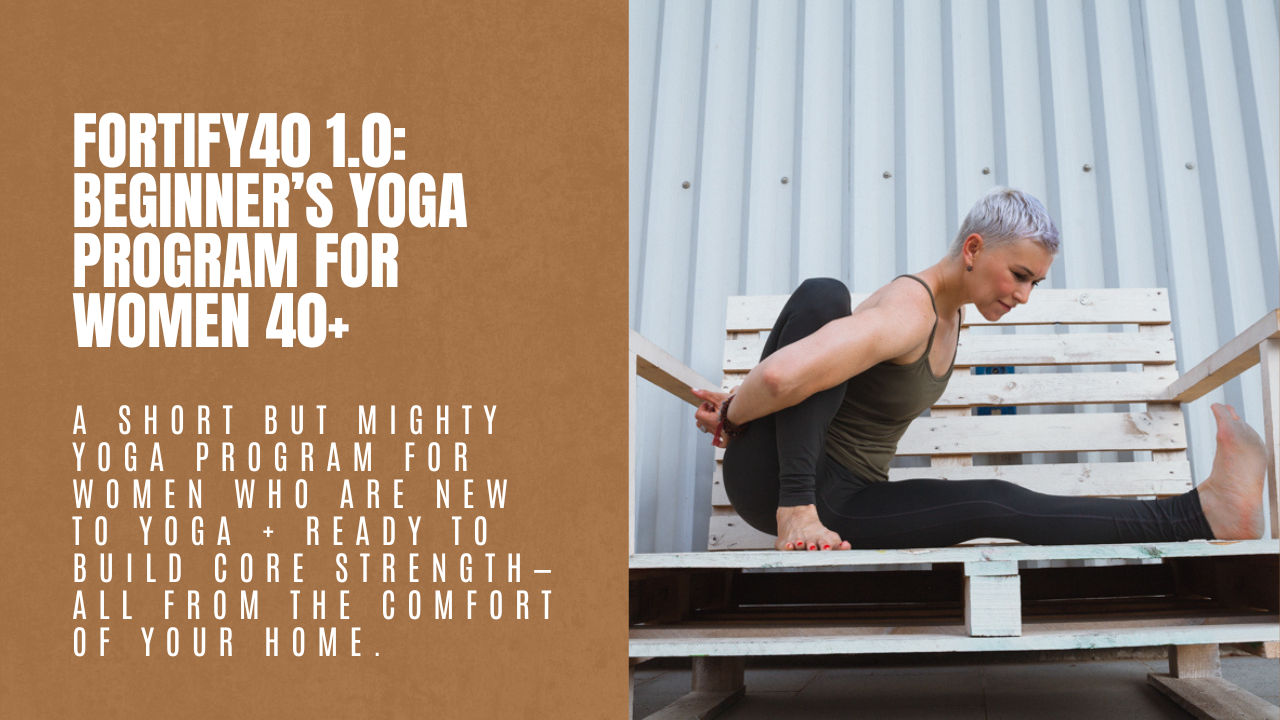
Not more workouts, random yoga classes or trying to figure it out on your own.
This is a simple, structured way to build core strength, stability, and support in your body… using yoga that *actually* makes sense for where you are right now.
👉 What We’re Doing Inside?
We’re focusing on strength - the kind that helps your back feel more supported. Your balance feel steadier. Your core actually do its job.
Each week has a clear focus (core, side body, back + glutes, pelvic floor)
You’ve got 2 classes a week
30 to 45 minutes
That you can actually fit into your life
And everything builds. So you’re not guessing, constantly starting over, or wondering if it’s working.
👉 This Was Designed With 3 Types of Women in Mind - See Which One Are You:
You’ve been doing a mix of classes, videos, or workouts… but you’re not actually feeling stronger, just a bit sore or inconsistent.
Your core doesn’t feel as supportive as it used to, your back gets tired more easily, your balance feels a little off… and you’re starting to notice it in everyday things.
You know strength matters, but most workouts feel like too much, too fast, or just not designed for your body right now.
👉 A Quick Note About Who This Is NOT for …
If you’re looking for something fast, intense, or a quick fix, this probably isn’t it. And if you love pushing hard, going all in, and that’s working for you, keep doing that. This is slower, more intentional, and built to actually last.
If you’re here, I’m assuming you already have a sense of how I teach… and whether this is something your body needs right now.
👉 If You Want In
We’ve already started, but you can still join and catch up easily.
Everything is inside and ready for you.