5 Unexpected Lessons About Progress on the Yoga Mat
Progress in Yoga Isn’t Linear (And That’s the Point)
Because growth in yoga isn’t linear. It’s layered, lived, and wildly humbling.
You’d think that after nearly two decades of practicing yoga, teaching it, studying it, living it, I’d have everything dialed in.
I used to think that too.
But the truth is, even after all these years, my practice is still evolving. Still shifting. Still teaching me things I didn’t expect to learn.
Recently I added strength training back into my routine alongside my yoga practice, and the experience has been eye-opening in ways I didn’t anticipate.
Not just physically. Mentally too. It’s forced me to rethink what progress actually looks like, not just in yoga, but in movement and fitness in general.
And honestly? The lessons are things I wish I could go back and whisper to my younger yogi self.
Because somewhere along the way, many of us absorbed the idea that progress in yoga should look like a straight line.
Practice more → Get stronger → Become more flexible → Do more advanced poses → Repeat.
But bodies don’t work like that. And yoga, real yoga, definitely doesn’t either.
The Timing Problem No One Talks About
Have you ever walked into a yoga class and known within the first five minutes…This is not the right pace for my body today.
Maybe the class feels too fast. Or too slow. Or strangely still, when what you actually needed was to move a little and shake things loose.
Nothing is technically wrong with the class. The teacher is great. The sequence makes sense, but something still feels off. So instead of listening to that gut nudge, we adapt.
We push harder to keep up. Or we hold back to stay safe. We override what we feel so we can match what’s happening around us.
But here’s the thing.
Timing matters.
Even in yoga. Especially in yoga.
Classes start at a set time.
There’s a warm-up, a peak, a cool-down.
Sixty minutes. Maybe seventy-five if we’re lucky.
And floating around the room is this quiet promise: If you show up consistently, progress will happen.
More strength, more openness, and maybe even more “advanced” shapes.
But bodies don’t actually work like that. Some days you feel strong, open, and ready to bang out chaturangas. Other days your body feels tight, heavy, and weirdly uncooperative.
Cue the bruised ego.
Some seasons invite effort. Others require rest, not as a reward, but as a requirement.
And here’s the part we don’t talk about enough:
Not every body is wired for the same timing.
Your nervous system. Your hormones. Your sleep. Your stress. Your natural rhythms. They don’t magically disappear when you roll out your mat.
They either get listened to…
Or overridden.
And when timing is imposed instead of felt, yoga quietly stops being a relationship. It becomes a compliance document. Boxes to tick. Gold stars to earn.
The Invisible Container You’re Practicing Inside
Every yoga practice happens inside a kind of container. You can usually feel it within minutes.
There’s the push-through container. Time feels tight. Rest feels optional. Stopping feels like falling behind.
Then there’s the be-careful container. Everything slows down. Movement gets smaller. Progress starts to feel limited.
And then there’s the ritual container. Time softens. Space feels safer. The mat isn’t a stage — it’s somewhere you come back to.
None of these containers are inherently bad. But they do shape your relationship with practice.
They determine whether yoga feels supportive…
Or like something you just need to get through.
You might recognize some of these thoughts:
“I keep skipping class and I don’t know why. I love yoga.”
“Every time I go, I leave feeling tight instead of calm.”
“I can’t make myself practice in the mornings anymore.”
Here’s a reframe that matters. It might not be a motivation problem.
It might be a timing problem.
My Own Timing Wake-Up Call
There was a stretch where my practice was full-on Ashtanga. Daily practice. Early mornings. Same sequence. Same schedule.
Same everything.
I was disciplined. Very serious. Very “this is what a good yogi does.”
On paper? Gold star.
In my body? Low energy. Tight hips. A nervous system that was not impressed.
But I ignored that feeling for a long time. Because discipline, right?
Push through. Don’t be dramatic. Just keep going.
Spoiler alert: It did not get better.
I stayed in that loop for almost two years; getting hurt, recovering, starting again, trying to live up to an idea of practice that looked good from the outside but felt terrible on the inside.
Eventually the question shifted.
Not: “What’s wrong with me?”
But:
What if the problem isn’t my commitment… it’s my attachment to the timing?
Letting go of the rigid schedule felt almost rebellious.
But it also felt like relief. And that shift changed everything, not just how I practice, but how I teach.
Because most people don’t need more discipline. They need permission to stop forcing a rhythm that no longer fits.
Lesson #1: More Isn’t Always Better
For years many of us believed something simple: If a workout doesn’t leave you drenched in sweat, it doesn’t count. If a class isn’t intense, it’s not productive.
Exhaustion equals effort → Effort equals results.
But that’s not how the body works.
Your body wasn’t designed to live in overdrive. When intensity becomes the default, eventually something gives.
Your joints ache.
Your recovery slows.
Your energy drops.
Yoga can look gentle from the outside, but slower doesn’t mean easier. Slowing down requires:
more control
more awareness
more precision
Real progress happens when you move well and recover well, so that you can show up again tomorrow.
Lesson #2: Your Body Is a Conversation
One of the biggest shifts in my practice happened when I realized something simple: Your body isn’t something you master. It’s something you partner with.
Progress doesn’t happen because you force flexibility or push harder. It happens when you start asking a better question:
What is my body saying today?
Some days the answer is: Move more.
Some days it’s: Slow down.
Some days it’s: Rest.
Listening isn’t weakness. It’s skill, and the longer you practice yoga, the more you realize that awareness is the real superpower.
Lesson #3: Muscle Matters {Especially After 40}
For a long time I thought yoga alone was enough. Flexibility. Mobility. Breath.
But returning to strength training changed my perspective. Muscle matters more than I used to think. Not for aesthetics. But for longevity.
Muscle supports your joints.
It stabilizes blood sugar.
It protects your spine.
It prevents injury.
As hormones shift in midlife, muscle becomes even more important and that’s why strength training has become a non-negotiable in my routine.
Yoga still plays a huge role. But now it sits on top of a stronger foundation. And honestly?
My yoga practice feels better because of it.
Lesson #4: Yoga and Strength Are Better Together
For years I thought I had to choose. Be a yogi. Or lift weights. But the truth is they complement each other beautifully.
Yoga taught me how to move with awareness.
Strength training gave me stability.
Yoga gave me mobility.
Strength training gave me power.
One student recently told me: “I used to collapse in chaturanga. Now that I’ve been lifting, I feel solid.” That’s the magic of combining both. You don’t have to choose.
Your body benefits from learning multiple movement languages.
Lesson #5: Progress Is Seasonal
This one took me the longest to accept.
Yoga progress isn’t linear. It’s seasonal. Some seasons you feel strong and energized. Other seasons you feel stiff, tired, distracted, or disconnected. Some seasons you practice every day. Other seasons you barely roll out your mat.
And guess what? You’re still a yogi.
Yoga doesn’t punish you for being human. It expects you to be.
Progress looks more like cycles than a straight line:
strong → tired → rebuilding
focused → distracted → returning
disciplined → curious → rediscovering
And the deeper your practice becomes, the more those cycles make sense.
What Real Progress Actually Looks Like
After nearly two decades on the mat, here’s my honest definition of progress:
Progress is when your practice starts supporting your life, not controlling it.
…when you stop chasing poses.
… when you stop forcing outcomes.
… when your mat becomes a mirror instead of a measuring stick.
… when breath matters more than achievement.
… when awareness matters more than aesthetics.
… when you trust your body enough to let it change.
Because it will. Yoga doesn’t freeze you in time. It evolves with you.
A Few Gentle Check-Ins
If you’re open to it, here are a few questions worth sitting with.
Not to solve. Just to notice.
When does my body actually feel available to practice?
Where do I tend to rush… or stall?
What season am I really in right now?
Am I practicing toward a future I chose… or one I inherited?
You don’t need perfect answers. Noticing is enough. That’s already practice.
Final Thoughts
If your goals around movement or yoga are shifting lately, that does not mean you are doing anything wrong. More often it means you are paying closer attention. The practice that worked five or ten years ago may not be the practice your body needs today, and that is not failure. It is awareness.
Some weeks your practice might look like a full class where everything feels strong and open. Other weeks it might be twenty quiet minutes on your mat, just moving enough to reconnect. Some seasons ask for more strength. Others ask for patience and recovery. The rhythm changes because bodies change.
Over time, the goal becomes less about doing yoga perfectly and more about staying in conversation with your body. Showing up, listening, adjusting. Letting the practice evolve instead of forcing it to stay the same.
That’s the kind of progress that actually lasts; the slow, layered kind that unfolds over years, not weeks. And when you start to see practice that way, the pressure to keep up or prove something tends to fall away.
You’re not behind. You’re simply practicing inside the season you’re in.
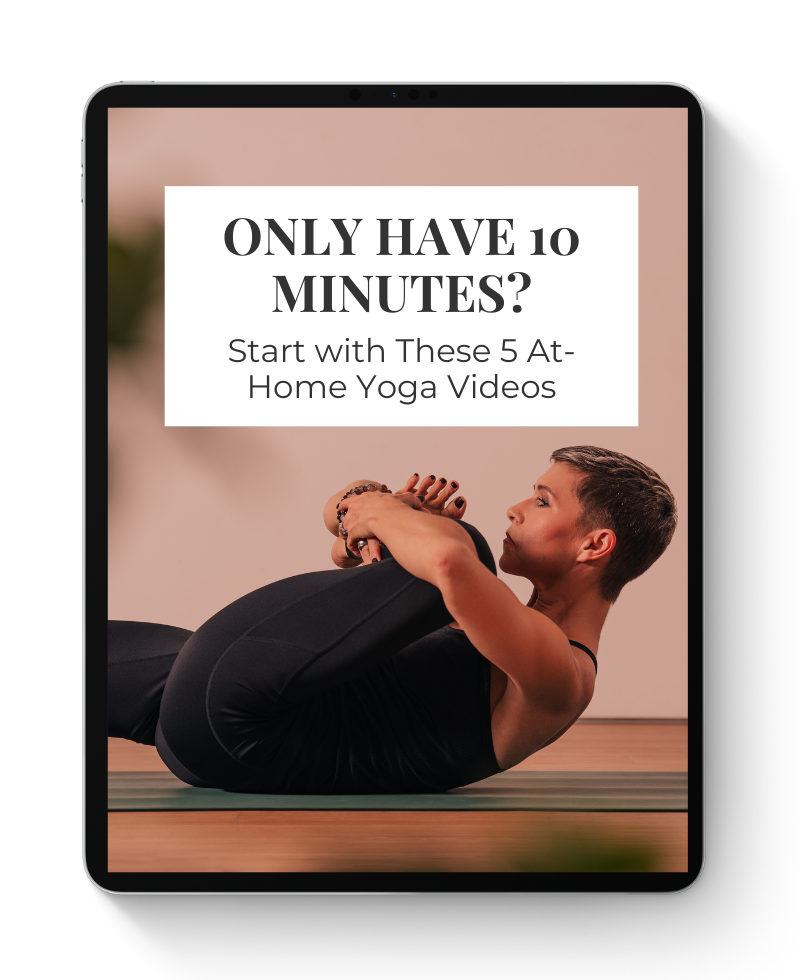
The nice thing about practicing this way is that it does not have to take much time.
Sometimes the most supportive practice is simply the one you can actually do. A few minutes of movement. A little space to breathe.
Enough to loosen your hips, settle your shoulders, and remind your body that it knows how to move.
If you’ve ever opened YouTube hoping to do yoga, felt overwhelmed by the options, and closed it again without moving, this series is meant to remove that friction.
I’ve put together five short yoga practices for women over 40.
Each video is about 10 to 15 minutes long and designed for the days when your body feels stiff, your mind feels busy, and you do not want to spend energy deciding what to do.