Strength Training and Yoga After 40: Why It Doesn't Have to Be Either/Or
A few honest things I've been thinking about… and a case for stopping the fight between two modalities that were never really competing.
I’m going to say something that might surprise you. I don’t think anyone has women’s fitness completely figured out.
Not the influencers, or the hormone experts. Not even the trainers shouting advice from every corner of the internet.
YEEEEET….
everyone sounds very certain.
→ The strength-training crowd will tell you yoga is just stretching.
→ The yoga world has occasionally made its own claims about being all you need.
Both sides have a point. And *both* miss something.
Because if you've been paying attention to your own body lately… you've probably noticed that the things that used to work don't always work the same way anymore.
😳 Recovery takes longer.
😳 Some movements your body tolerated before suddenly feel not worth the trouble.
😳 And the question underneath all of it is the same:
Am I doing the right kind of movement for the body I have right now?
So instead of pretending certainty today, here are a few things I've been thinking about {and honestly still figuring out} when it comes to strength, movement, and yoga after 40.
1. Strength training matters. So does yoga. And they mean different things.
You'll hear this everywhere now: "Women over 40 need strength training."
And yes, that's probably true. Bone density, muscle mass, joint support… it all matters more as we get older.
Barbells, dumbbells, resistance work. These things are genuinely valuable, and I'm not here to talk anyone out of them.
BUT.
Strength training doesn't only happen in a weight room. And yoga isn't only stretching.
✓ Strength also shows up as holding your own body weight through a controlled range of motion.
✓ As time under tension in a pose your legs are already burning in.
✓ As stability work that protects the joints that every other workout relies on.
The real question:
Instead of asking "Am I lifting heavy enough?" try asking: Am I building strength that supports how I want my body to move and feel in the months and years ahead? Sometimes that looks like weights. Sometimes it looks like a controlled yoga practice. And *often* it looks like both.
TRY THIS »
Next time you're in Warrior II, stay there for a few extra breaths. Notice your legs working. In Chair Pose, lower just a little deeper and hold. Your thighs will tell you what's going on pretty quickly.
Strength often comes from time under tension, not just heavier weight.
2. Flexibility alone isn't enough. Neither is strength without mobility.
For years yoga was marketed as stretching: touch your toes, open your hips, get more flexible.
The strength world, meanwhile, sometimes treats mobility work as optional.
But both of those gaps cause problems.
Flexibility without strength leaves joints doing more work than they should.
Strength without mobility means you're working hard in a limited range, and eventually, something will complain about it.
What actually supports a body long-term is these three things working together:
Strength: so the muscles around a joint can do their job.
Mobility: the ability to move a joint through a healthy range of motion.
Stability: what keeps that movement controlled and supported.
When those three show up together, joints tend to feel better and move better over time.
⚠️ When any one of them is missing, whether that's a lifter who never works on range of motion or a yogi who's deeply flexible but not particularly strong around those flexible joints, that's when irritated knees, cranky hips, and a low back doing everyone else's job tend to show up.
Try this »
In a forward fold: instead of dropping straight into the deepest version, fold halfway and pause. Engage the muscles in the back of your legs, then slowly lower in.
That small shift moves it from passive stretch to active mobility work. Muscles stay involved, joints stay supported. That principle applies whether you're on a mat or in a gym.
3. After 40, consistency tends to beat intensity in any modality.
In your 20s and 30s, you could often get away with sporadic effort. A tough session here, nothing for two weeks, then another intense push when motivation returned. Your body usually tolerated that pattern without much trouble.
After 40, that tends to stop working, and it doesn't matter whether we're talking about weightlifting or yoga.
Muscles and connective tissue simply take longer to repair and adapt. When sessions are spaced too far apart, the body never really has a chance to build on the previous one.
This is one place where yoga has a natural advantage.
^^^The barrier to showing up for a 15-minute practice is genuinely lower than gearing up for the gym.
BUT. The same principle holds for any movement: shorter, more frequent sessions often build more than longer, occasional ones.
The shift:
Focus on frequency first. 3 or 4 sessions a week, whatever form they take, gives the body the repetition it needs to actually adapt.
Consistency doesn't have to look impressive. It just needs to happen often enough.
4. The body you have today deserves support. Not punishment, not comparison.
This might be the biggest shift of all. Bodies change. Muscle mass gradually declines with age, connective tissue becomes less elastic, and joints often need more muscular support to move comfortably.
The instinct can be to push harder, to try to force the body back to what it used to do.
But after 40, the more useful question isn't "why can't I do what I used to?"
It's: "what kind of movement actually supports the body I have right now?"
⚒️ That might be lifting weights twice a week and doing yoga on the days in between.
⚒️ It might be strength-based yoga that covers both bases.
⚒️ It might be something else entirely.
The point is that none of these approaches need to fight each other, and the women I see make the most progress are usually the ones who stopped treating it as a competition.
A useful filter »
Instead of choosing movement based only on intensity or calorie burn, pay attention to how your body feels after the practice, and the day after that.
💡Choose movement that helps your body feel stronger and more supported… not just more exhausted.
So what does this look like in practice?
Honestly? I keep things fairly simple.
Some strength training. Short yoga practices focused on stability and mobility, done regularly. Nothing fancy. Just a combination that helps me feel capable in this 47-year-old body, rather than at war with it.
If you've made it this far, you probably already sense that it's not about finding the one right method.
It's about finding a combination that actually fits the version of you that exists right now: the one with a full schedule, shifting energy, and a body that doesn't always respond the way it used to.
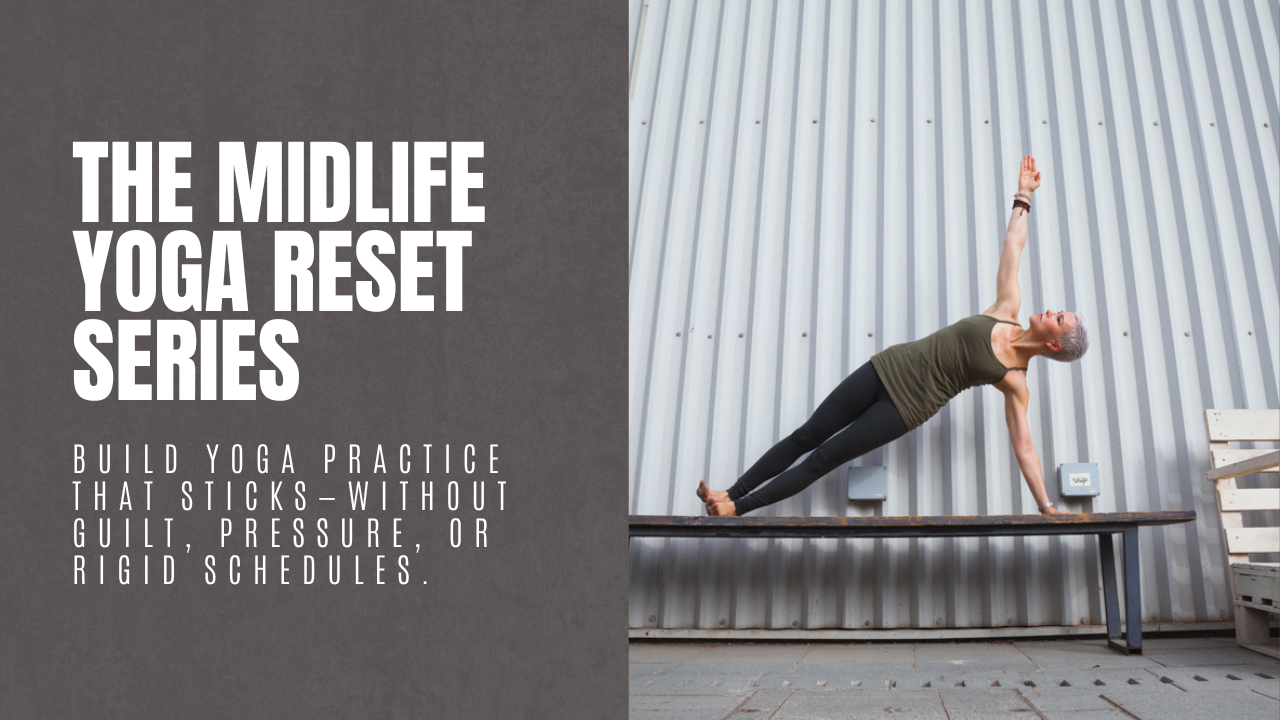
A simple 5-day series designed to help you rebuild strength and mobility in a way that feels steady, supportive, and actually doable. Not just on your best days, but on your real ones.
Nothing extreme. Nothing to keep up with. Just a place to begin again… without starting from scratch every time.
And if nothing else, let this be your reminder… you don’t need to push harder. You just need something that meets you where you are.