Is Yoga Enough in Your 40s? Why Strength Starts to Matter More
…and the day I realized flexibility alone, wasn’t going to carry me through midlife.
Your 40s are the decade when your body starts to quietly tap you on the shoulder. A little “Anyone home?”
And if you’re a woman navigating perimenopause, or right in the thick of it, you probably know exactly what I mean.
Anyway.
Here’s what happened.
The Dumbbell Incident
I agreed to join my husband at the gym. Mostly because my algorithm kept pushing things like “Women need to lift heavy sh*t,” in a way that felt suspiciously accurate.
So I went.
He handed me a pair of dumbbells. “Try these,” he said.
Very casual. Very innocent.
I thought: Of course. Eeeeeaasy.
I do yoga. I can touch my toes. I can balance on one foot.
Surely I can pick up a couple of five-pound weights.
Turns out… touching your toes and lifting something are not the same skill!!
I wasn’t weak. But I wasn’t strong either.
And yes, I did what any reasonable person would do. I Googled “how much strength do you lose at 40.” Lol.
Zero stars. Do not recommend.
When the Dumbbells Became a Midlife Mirror
The deeper I spiraled, the clearer it became. I hadn’t “lost” strength. I had never truly trained it.
I treated strength like an optional upgrade. Nice to have someday. A “when things settle down” kind of goal.
Except someday never arrives on its own.
And in your 40s? Strength isn’t optional anymore. It’s the seatbelt, not the heated seats.
Annoying to admit, but wildly an eye-opener.
A Quick Zoom Out
Here’s the truth I wish more women were told in their 20s and 30s.
Your 20s carry you on hormones. Your 30s carry you on multitasking and a healthy dose of denial, and your 40s carry you… until they don’t.
Strength doesn’t disappear because you “got old.” It fades because you stopped training it.
And yes, we all know flexibility keeps you soft and spacious, but strength is what keeps you steady, mobile, and aging well.
Yet so many of us double down on gentle movement because it feels familiar and comforting.
And just to be clear, those practices help. They matter. I love teaching them.
BUUUUUT.
They cannot be the only tool you lean on when your body is shifting through the very real changes {and sometimes very unglamorous sh*ts} of perimenopause.
Meanwhile, your muscles are raising their hands like, “We could use a little help,” and your bones, digestion, and brain fog are all joining in the background like a midlife choir.
flexibility and mobility. you need both.
Part of the reason we hit this wall is because no one explains the difference between flexibility and mobility.
Flexibility is PASSIVE.
It’s your body being moved into a position with the help of gravity, momentum, a strap, or even your own hands.
>>> Think hamstring length in a forward fold or a deep quad stretch where you pull your foot behind you.
Flexibility feels good because it makes you feel open, soft, and spacious. Yoga gives you plenty of that.
Mobility, though, is ACTIVE.
It’s your ability to move into a position and actually control that position using your muscles.
It’s lifting your leg into Warrior III without momentum.
It’s lowering into a squat without collapsing.
It’s stepping forward from Down Dog with intention instead of flinging your foot somewhere near your hands.
And in midlife, mobility matters even more than flexibility.
Flexibility gives you access. Mobility lets you own that access.
You don’t need much strength to be flexible, but you need strength to be mobile.
This is the difference between feeling open and feeling *capable*.
One makes you bendy. The other keeps you steady, safe, and aging well.
Here’s the good news most women never hear: yoga trains BOTH.
Strength-focused yoga builds mobility through:
Loaded positions
Slow transitions
Balance challenges
Eccentric lowering
Intentional breath
Muscular engagement
Every time you hold Warrior II with intention, step forward slowly, stabilize instead of collapse, or move with control, you’re building strength and mobility at the same time.
Flexibility is lovely. Mobility is essential.
Both matter, but they’re not interchangeable.
And at this stage of life, your body needs the one that keeps you stable, supported, and strong, not just the one that makes you feel more open.
How Strength Actually Works {and why yoga absolutely counts}
Let’s clear something up. Strength comes from one thing:
Your muscles feeling enough tension, long enough, that they have to adapt.
That’s it.
Your muscles don’t care if the resistance comes from:
✓ a barbell
✓ a dumbbell
✓ a kettlebell
✓ or your own bodyweight in a yoga pose
They only care about the tension.
And there are 3 ingredients that help you build strength:
Tension: Your muscles must work against something. Bodyweight absolutely counts.
Progression: The challenge increases over time. Longer holds, deeper angles, slower movement, more reps. It all works.
Fatigue: Not collapse-on-the-floor fatigue. Just enough to create change.
If those three are present, you will get stronger. No debate. This is physiology.
So YES. Yoga builds strength.
However, most people just haven’t been taught how to practice it that way.
Because in yoga:
Plank loads your core.
Chair loads your legs.
Warrior II loads your hips, legs, and shoulders.
Chaturanga is a bodyweight chest press.
Your body is the weight.
Gravity is the resistance.
Your awareness is the progression.
And women in midlife benefit from this more than anyone.
Better bone density. Better muscle retention. Better stability. Better energy. Fewer injuries. More confidence.
Yoga doesn’t need to be replaced. It just needs to be practiced with intention.
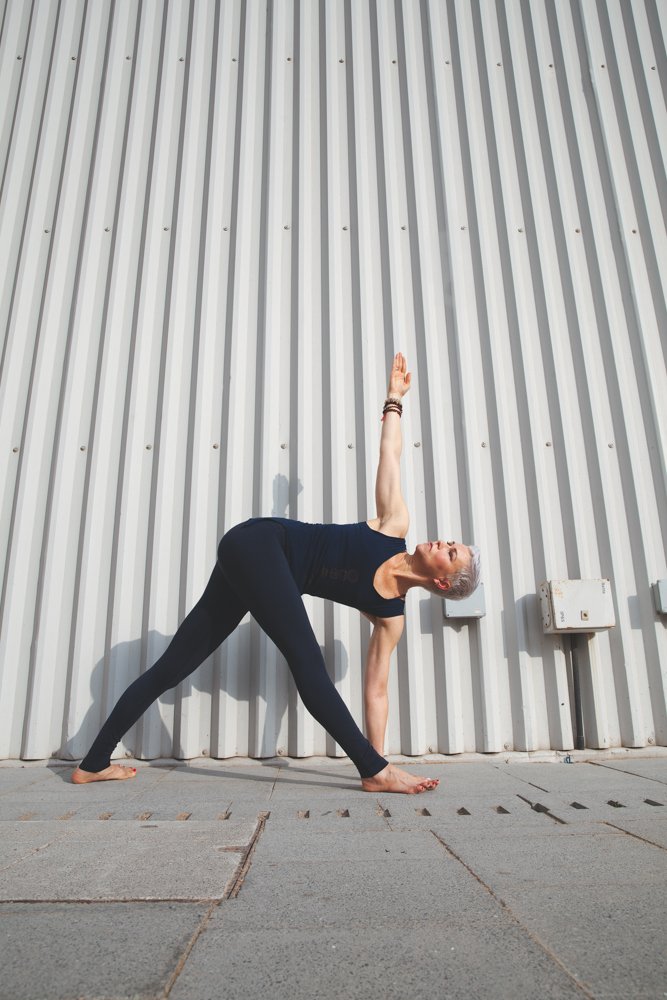
If this BLOG POST felt a little too familiar - the stiffness, the strength gap, the realization that stretching alone isn’t cutting it anymore…
…you don’t need more yoga. You need yoga that’s doing the right work.
I created Strength Yoga: Core Foundations, a free 3-part training that shows you how to build real, supportive strength through yoga, starting at the core.
Short classes. Simple cues. No intensity for the sake of it.
Just a smarter way to practice yoga in this chapter.
Back to the Mat
Once the dust settled, I realized I didn’t need to abandon yoga or sign up for a hardcore gym program.
I just needed to change the way I practiced yoga.
More engagement.
More deliberate loading.
More awareness of what my muscles were actually doing.
Small shifts. Big impact.
What Strength YOGA Gave Me {besides SUPER TONED arms}
Here’s the truth: At 47, my yoga practice feels better than it did a decade ago.
Not because I’m more flexible. I’m not.
But because I’m more supported.
I can lift things without talking myself into it.
My balance feels predictable again.
My energy lasts longer.
My body feels like mine.
And if you’re in your 40s or beyond, here’s something to tuck into your pocket:
You’re not fragile. You’re not “declining.” You’re just out of practice.
And out of practice is fixable.
So… What Now?
Start small. Start slow. Start where you are.
Two strength-focused yoga sessions a week is enough. Truly.
Ask yourself:
Do I feel steadier? Do I feel more supported?
These are the new metrics.
Add strength in layers, like building “lasagna”. One layer at a time.
Your body will meet you halfway. It always does.
Final Thoughts: Strong Is the New Flexible
Yoga in your 40s isn’t about touching your toes.
It’s about HOW your body moves. How steady you feel. How much strength you carry into the everyday moments; twisting, reaching, lifting a suitcase, living your life.
Midlife changes things: muscle tone dips, hormones wobble, recovery shifts. Stretching alone stops being enough.
And flexibility without strength?
That’s when your back, hips, and joints start talking back.
The answer isn’t overhauling your life or joining a gym six days a week.
It’s practicing yoga in a way that builds strength and supports you through this chapter; steady, strong, and deeply capable.
If you’ve been craving movement that actually helps you age well… strong muscles, stable joints, and energy that lasts…
This is your sign.
You don’t need your 20-year-old body back. You just need the one you already have. Supported in the right ways.

If this hit home….
…and you’re starting to realize your yoga practice needs to evolve with you, you’ll probably appreciate my weekly emails.
I share straightforward, midlife-specific yoga guidance that actually explains what’s happening in your body and how to support it with strength, mobility, and intentional yoga practice.